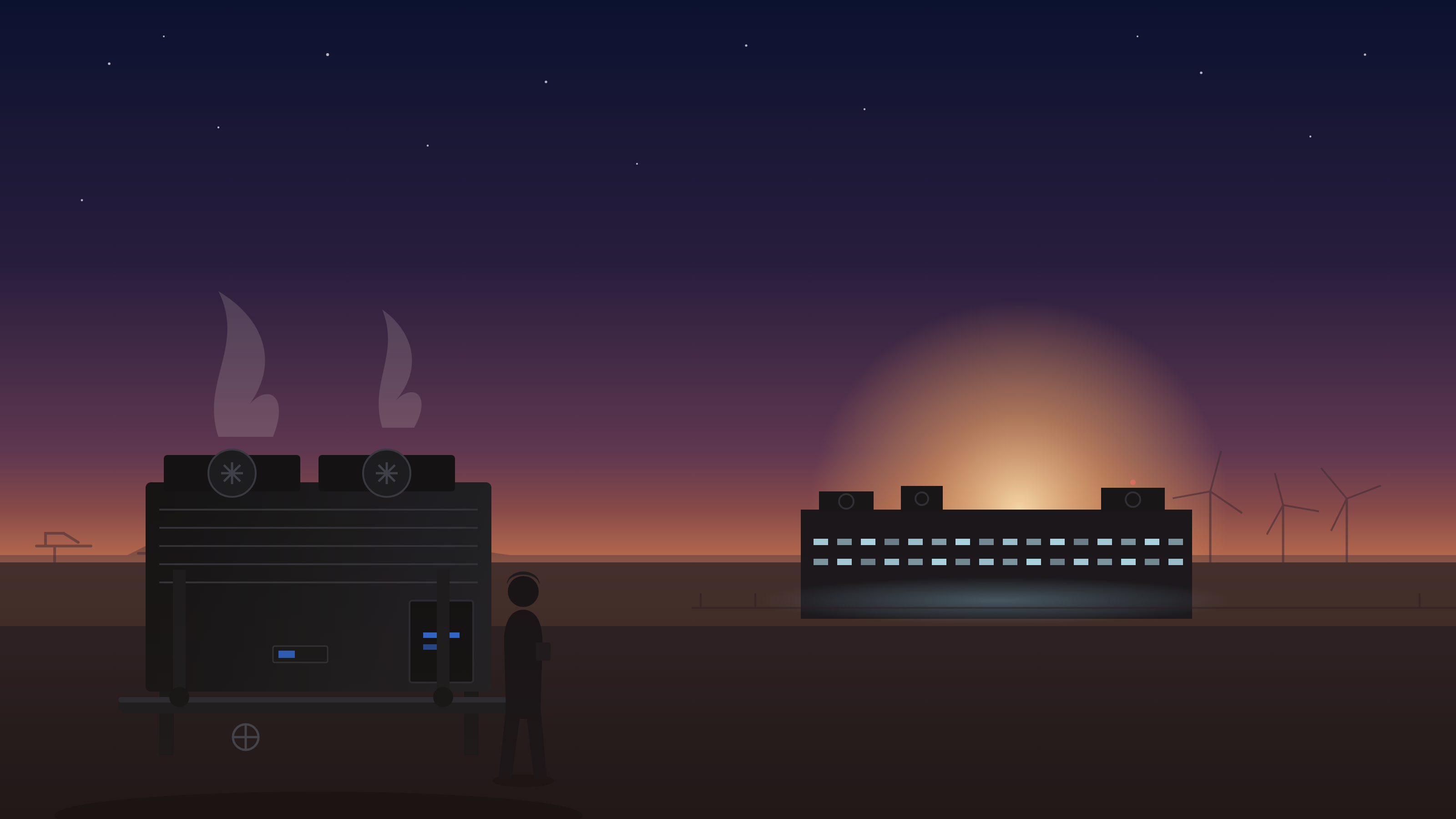
West Texas is in the middle of a construction boom unlike anything most of us have seen. The demand for computing power, cloud infrastructure, and artificial intelligence has created a need for new facilities and massive mechanical and electrical build-out — and for HVAC companies and other contractors, the opportunity is real. Cooling, controls, electrical infrastructure, pumps, equipment maintenance, contingency planning, and specialized technical service are all in demand at a scale this region hasn't experienced before.
At the same time, rapid growth brings challenges that deserve honest discussion. Opportunity and long-term sustainability are not always the same thing, and the pace of this development is forcing established contractors, employees, small businesses, and residents across the region to adjust in real time. This isn't an argument against the data center industry or against growth. It's a case for thinking further ahead than the current phase of construction — because the decisions made now will shape what these communities look like once the buildings are finished and the crews have moved on to the next project.
Why This Is Happening Here
It's worth understanding why West Texas specifically has become such an attractive location for this kind of development, because the reasons matter for how the region should plan around it. Available land, expanding power generation capacity, growing fiber infrastructure, and lower exposure to the kind of natural disasters that threaten data centers on the coasts have made this region genuinely competitive for hyperscale and enterprise facilities. Add in local and state incentives built to attract large capital investment, and it's easy to see why developers are moving quickly here.
Those advantages aren't going away. This isn't a short cycle that resolves itself — it's a structural shift in the regional economy that established businesses and local governments need to plan around for years, not months.
When Speed Drives the Market
Data center projects are complex and time-sensitive, and owners and developers have real reasons to move fast. Delays affect construction schedules, financial commitments, and the availability of computing capacity the moment it's needed. But when project schedules compress, contractors and suppliers can end up operating in an environment where immediate capacity matters more than long-term strategy.
Labor is needed immediately. Equipment is needed immediately. Technical support is needed immediately.
Established local HVAC and mechanical companies get the call in those moments because they have the experienced people, the equipment, the local knowledge, and the ability to respond fast when something has to happen now. They rearrange schedules. They move people. They dedicate equipment and resources that had been planned for other customers. That willingness to step up during a crisis is exactly what good service companies have always built their reputations on — but it can also create real exposure for the companies providing it.
Here's the part worth saying plainly: the contractors who show up during the most demanding stretch of a project don't always become the contractors selected for the next phase of work. Procurement strategies shift once construction stabilizes. Requirements change as a facility moves from commissioning into ongoing operations. Larger national service contracts eventually replace the local relationships that got a facility through its most urgent period. Cost and capacity become the deciding factors once the emergency that created the relationship has passed.
There are understandable business reasons behind those decisions, and no facility owes a contractor indefinite loyalty just because of past performance. But it can be genuinely frustrating for a local company that made real commitments — rearranged crews, turned away other work, invested in equipment — to solve someone's urgent problem, only to watch the relationship end the moment things stabilize. The point isn't that every relationship should last forever; healthy competition matters, and facilities should always have the ability to evaluate their options. The point is that responsiveness and proven performance should still count for something once a project moves from crisis mode into steady-state operation, rather than being treated as a commodity the moment the pressure is off.
The Workforce Challenge
Perhaps the most visible effect of rapid data center development is competition for skilled labor. Experienced HVAC technicians, electricians, controls specialists, project managers, operators, welders, and other tradespeople are already difficult to find in normal conditions. Established contracting companies spend years recruiting, training, mentoring, and developing the people who fill those roles — it isn't a workforce that can be built overnight, no matter how much demand shows up at once.
When a rapidly expanding market creates demand for large numbers of skilled workers all at the same time, compensation naturally increases. For employees, that can be a genuine and legitimate win. Higher wages improve financial security, support families, and open career advancement that might not have existed otherwise. Those benefits shouldn't be overlooked just because they're inconvenient for employers.
The challenge for the local contracting market is what happens when compensation temporarily rises well beyond traditional industry levels in a short window of time. An established HVAC company cannot always immediately adjust every wage and billing structure to match a rapidly inflated labor market, because its existing customers, service agreements, maintenance contracts, and long-term pricing models were built under different economic conditions.
When experienced employees leave for higher pay elsewhere, companies lose more than available manpower. They lose institutional knowledge, customer relationships, technical experience, and years of training investment that don't come back quickly, even with successful recruiting. Remaining employees often absorb heavier workloads. Response times can slip. Recruiting and training costs rise just to stay level, let alone grow.
That strain doesn't stop at the contractor's door. Hospitals, schools, commercial facilities, municipalities, and manufacturing companies all rely on the same local service providers competing for the same shrinking pool of experienced trades. If the established workforce supporting those facilities becomes harder to maintain, the entire local service market feels the effect — not just the companies chasing data center work directly. This is part of why apprenticeship and training pipelines matter more now than ever: the companies that keep investing in developing their own people, rather than only competing to poach someone else's, are the ones best positioned to weather this kind of labor market swing without losing what makes them reliable in the first place.
Growth's Uneven Impact
Data center construction brings substantial economic benefit to an area. Construction activity creates opportunity for contractors, suppliers, transportation companies, equipment providers, hotels, restaurants, and many other businesses. Companies capable of supporting the development can experience real growth, and communities benefit from increased economic activity and new investment. Those are important positives, worth stating clearly rather than glossing over in a piece focused on the risks.
The challenge is that the benefits of rapid development aren't always distributed evenly. Not everyone in a growing community works for a data center, a contractor, or a business directly riding the wave. Teachers, healthcare workers, public employees, retail workers, and residents in other industries can feel every downstream effect of rapid growth — rising housing demand, higher rents, more congested traffic, greater strain on local services — without seeing any of the income growth that's driving it. A family that's lived in an area for years can suddenly find that everyday life has gotten a lot more expensive, through no fault of their own and without a corresponding raise to offset it.
None of that makes growth inherently negative, and economic opportunity isn't something communities should shy away from. But rapid growth requires communities to think seriously about the people and businesses affected indirectly, not just the ones directly benefiting. The question shouldn't simply be how much development can occur. It should also be how communities remain healthy, affordable, and desirable places to live while that development is happening around them.
Building Relationships That Last Beyond Construction
The HVAC and mechanical industry has always run on relationships. When equipment fails at 2 a.m., people remember who answered the phone. When a facility has a critical failure, they remember who mobilized technicians on short notice. When equipment or materials are difficult to find, they remember who worked through the problem and found a solution instead of citing supply chain excuses.
That trust is worth building on as data center facilities move from construction into long-term operation — and it's worth building deliberately, not just assuming it will carry over on its own. Local companies that have demonstrated responsiveness, technical ability, and a willingness to support difficult situations bring real, ongoing value that a facility loses if it moves entirely to procurement-driven, lowest-cost relationships once construction pressure eases. This doesn't mean a facility should never change contractors or evaluate other options; healthy competition keeps everyone sharp. It means weighing the full value a proven local partner provides, not just the line-item cost — because responsiveness, trust, local knowledge, and demonstrated performance under pressure are much harder to rebuild once they're gone than they are to maintain.
One of the greatest opportunities in this industry right now is developing strategies that extend beyond the initial rush to get facilities operational: building local contractor relationships early, well before the urgent phase of a project begins; real workforce planning instead of reactive hiring; thinking about infrastructure, housing, and utilities at the community level, not just the facility level; and developing contingency plans before emergencies occur rather than discovering the gaps in the middle of one.
It also requires recognizing that local contractors can't manufacture experienced workforces overnight just because demand showed up quickly. Skilled trades require time, training, mentoring, and years of accumulated experience that no amount of urgency can compress. Facilities and developers that build that reality into their planning — rather than treating labor like a commodity that scales instantly with demand — end up with more stable, more capable partners over the long run.
What Should Actually Change
If there's a practical takeaway here, it isn't "slow down." It's "plan further ahead than the current phase of construction." A few things worth doing differently, depending on where you sit in this:
For facility owners and developers: build local contractor relationships before the urgent phase starts, not during it, and weigh proven responsiveness alongside cost and capacity once procurement decisions get made after commissioning — the company that solved your 2 a.m. problem earned more than a one-time thank-you.
For contractors: be honest about what you're actually building when you take on this work — a long-term relationship, or a short-term surge you're staffing up to support. Both are legitimate, but they call for different choices about hiring, wage structure, and how much you stretch your existing customers to make room for new demand.
For communities and local leaders: treat housing, workforce development, and infrastructure planning as part of the growth conversation from the beginning, not an afterthought once the strain is already visible.
Protecting What Made This Place Worth Building In
West Texas has long been known for qualities that don't show up on a financial statement — strong relationships, hard work, loyalty, community, and a willingness to help one another when there's a need. Rapid development doesn't have to erase any of that. But unmanaged growth can quietly change the dynamics that made an area attractive in the first place, if no one is paying attention while it happens.
The goal was never to prevent growth. It's managing growth so that communities, existing businesses, new businesses, and residents all benefit over the long term — not just the companies and individuals positioned to capture the immediate upside. This industry will likely shape the region for years to come, and the challenge is making sure the urgency of today doesn't quietly crowd out the planning tomorrow is going to need.
That opportunity gets stronger, not weaker, when growth is accompanied by real planning, real relationships, and real respect for the people and communities already here. Years from now, the hope is that the communities experiencing this boom are still known for the same qualities that made them worth investing in before the next major development ever arrived.
Economic progress and community stability don't have to be opposing goals. With thoughtful planning and a long-term perspective, they can exist together.


